TIRE CENTER · Damage, wear & replacement
Repairable vs. non-repairable punctures
Could this puncture be repaired?
A small puncture in the middle of a passenger or light-truck tire’s tread may be eligible after inspection. The middle road-contact area is the crown; its curved edges are the shoulders; the flexible sides are the sidewalls. Damage extending into the shoulder or sidewall is not eligible.
Why the tire comes off the wheel
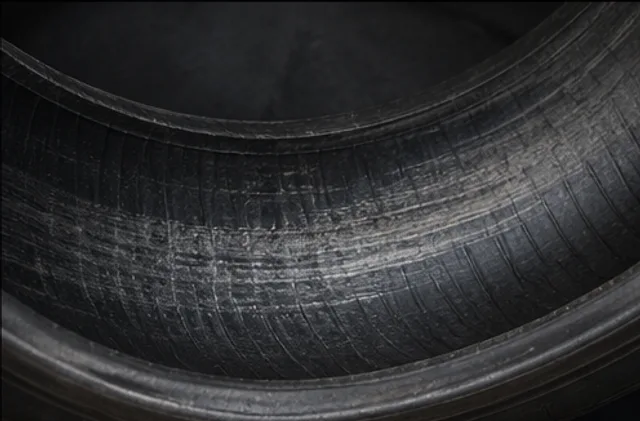
The outside hole cannot show the full injury. The tire must come off the wheel so a professional can inspect the inside for damage. Driving with too little pressure can damage the inside even when the outside looks ordinary; this is run-low damage.
2 · Injury route inside
Proper plug-and-patch repair
A complete repair fixes two places: the plug portion fills the hole through the tire (the injury channel), and the patch portion seals the air-holding inside surface (the inner liner). Professionals call this a combination repair. Suitable one-piece units or appropriate two-piece systems can do both jobs.
Outside-only plug
Patch-only
Complete system
From inspection to finished repair
Professional overview, not a DIY repair tutorial.
1 · Tire off, inside inspected
2 · Repairable hole prepared
3 · Hole filled + inside sealed
4 · Repair checked, tire reassembled
When replacement is needed—and what to do
Under standard passenger and light-truck puncture-repair guidance, punctures larger than 1/4 inch (6 mm) are not eligible. Hidden liner or structural damage, overlapping previous repairs and tire construction can also prevent repair. Under USTMA guidance, a tire with an existing improper repair must be scrapped.
Manufacturer restrictions may be tighter, including on some run-flat products. These passenger/light-truck rules are not universal repair rules for commercial, agricultural or specialty tires.
Do not pull out the nail or drive a deflated or visibly unsafe tire to test it. Arrange assessment or assistance; a tire disqualified by non-repairable damage requires replacement. Tell us about pressure loss or driving low and share a useful photo, without treating it as repair approval.
Sources and Technical Notes
Technical concepts reviewed 2026-10-10. Actual application instructions remain controlling.
- USTMA passenger/light-truck puncture procedures (opens in a new tab)
- USTMA Care and Service of Passenger and Light Truck Tires (2017 edition, currently hosted) (opens in a new tab)
- USTMA: Tire Repair Basics (opens in a new tab)
Application-specific details and scope
USTMA’s passenger/light-truck procedures exclude shoulder/belt-edge extension, including angled injury paths, and overlapping repairs. Manufacturer restrictions can be tighter, particularly for some run-flat products; repair count or visible nail size alone cannot establish eligibility.
REMA is a repair-product brand, not an industry standards organization. Appropriate one-piece and two-piece systems can meet USTMA’s fill-and-seal requirements. These procedures are not universal specifications for agricultural, commercial or other specialty tires.